Pay in installments of $5.33 with
 ,
,
 and
and

Shipping Estimate
USA
- USA
- CAN
- USA
- CAN
Ships within 48 hours · Estimated delivery Jul 21 - Jul 26
 Promo Codes Available:
For Your Every Summer RSVP, with Code: SUMMER15
Description
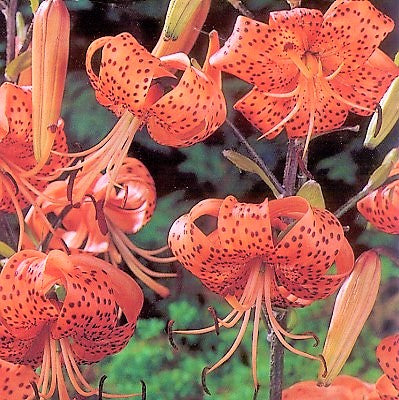
partylite tiger lily Tiger Lily Species Lily – The Lily Pad Bulb FarmLilium Tigrinum (lancifolium) is an heirloom favorite, quite properly known as the "Tiger Lily" of "Grandma's garden" fame. It has large unscented pendant orange flowers with black spots and recurved tips. It is a notoriously vigorous grower and naturalizes easily, producing a big crop of stem "bulblets" every year and aerial bulbils (resembling black beads thickly arranged along the stem). Once they develop rootlets, these bulbils can be easily
Lilium Tigrinum (lancifolium) is an heirloom favorite, quite properly known as the "Tiger Lily" of "Grandma's garden" fame. It has large unscented pendant orange flowers with black spots and recurved tips. It is a notoriously vigorous grower and naturalizes easily, producing a big crop of stem "bulblets" every year and aerial bulbils (resembling black beads thickly arranged along the stem).
Once they develop rootlets, these bulbils can be easily raised to blooming size, in fact will plant themselves if allowed to drop to the ground. If you seek a rapidly-propagating lily, this one's FOR YOU! In the Orient this species is raised for its edible bulbs (delicious in veggie stir-fry dishes. Very enduring and virus-resistant. We barely keep up with the revival of demand for this hard-to-get species. 16-18 cm bulb size. Choose between 1 bulb or a 3-pack.
Once they develop rootlets, these bulbils can be easily raised to blooming size, in fact will plant themselves if allowed to drop to the ground. If you seek a rapidly-propagating lily, this one's FOR YOU! In the Orient this species is raised for its edible bulbs (delicious in veggie stir-fry dishes. Very enduring and virus-resistant. We barely keep up with the revival of demand for this hard-to-get species. 16-18 cm bulb size. Choose between 1 bulb or a 3-pack.
Botanical name: Lilium lancifolium 'Splendens'
Form: Perennial
Hardiness Zone: 3-9
Flower Color: Orange/black spots
Foliage Type: Linear, green leaves arranged in whorls or spirals up the stems
Bloom time: July-August
Height: 3-4 ft
Spread: 12 inches
Light requirements: Full or partial sun
Plant depth: 6 inches of soil over top of bulb
See "Growing Tips" for more detailed instructions
Form: Perennial
Hardiness Zone: 3-9
Flower Color: Orange/black spots
Foliage Type: Linear, green leaves arranged in whorls or spirals up the stems
Bloom time: July-August
Height: 3-4 ft
Spread: 12 inches
Light requirements: Full or partial sun
Plant depth: 6 inches of soil over top of bulb
See "Growing Tips" for more detailed instructions
Tips and Growing Instructions
Visit our How-To Cultivation Library for more growing tips.
Species lilies, also known as Tiger Lilies, are wild lilies, native to North America, Europe, and Asia. Delicate and full of charm, there are 80 - 100 accredited Species. Most species lilies do not require specialized care and will naturalize themselves very well. They are very adaptable to most soil conditions and environmental conditions, and they do quite well in warm, moist climates with fertile soil. Tiger Lily bulbs for the most part are smaller than hybrid varieties, but will produce good quality stems and a lot of blooms. Their delicate, beautiful flowers are quite showy and most will bloom for long periods compared to other lilies.
Lilies are incredibly easy to grow and few garden pests trouble them. The most natural location for lilies is on sloping ground with excellent drainage. Lilies prefer to have their blooms in the sun and their roots in the shade. Try planting them among annuals or perennials that will keep their roots cool.
The general rule of thumb for planting spring bulbs is to plant two to three times as deep as the bulb is tall. This means that some of our larger Bulb-Zilla lily bulbs will need to be planted 6-8 inches deeps. Plant with the roots downward and the scales upward. After planting, water well two or three times. Lilies are most effective when planted in groups of three or more. Space them about a foot apart – they will spread and fill this space in no time!
Always allow the leaves on the stalk to turn yellow and fall off as part of the lily’s natural growth process. This ensures that the bulbous underground part of the plant has gotten enough nourishment and will mean greater growth next year. Each year watch their beauty increase as they multiply!
Visit our How-To Cultivation Library for more growing tips.
Species lilies, also known as Tiger Lilies, are wild lilies, native to North America, Europe, and Asia. Delicate and full of charm, there are 80 - 100 accredited Species. Most species lilies do not require specialized care and will naturalize themselves very well. They are very adaptable to most soil conditions and environmental conditions, and they do quite well in warm, moist climates with fertile soil. Tiger Lily bulbs for the most part are smaller than hybrid varieties, but will produce good quality stems and a lot of blooms. Their delicate, beautiful flowers are quite showy and most will bloom for long periods compared to other lilies.
Lilies are incredibly easy to grow and few garden pests trouble them. The most natural location for lilies is on sloping ground with excellent drainage. Lilies prefer to have their blooms in the sun and their roots in the shade. Try planting them among annuals or perennials that will keep their roots cool.
The general rule of thumb for planting spring bulbs is to plant two to three times as deep as the bulb is tall. This means that some of our larger Bulb-Zilla lily bulbs will need to be planted 6-8 inches deeps. Plant with the roots downward and the scales upward. After planting, water well two or three times. Lilies are most effective when planted in groups of three or more. Space them about a foot apart – they will spread and fill this space in no time!
Always allow the leaves on the stalk to turn yellow and fall off as part of the lily’s natural growth process. This ensures that the bulbous underground part of the plant has gotten enough nourishment and will mean greater growth next year. Each year watch their beauty increase as they multiply!
Shipping
Sorry, we do not ship outside the U.S. or to Hawaii due to agricultural restrictions.
We guarantee safe arrival of healthy bulbs, that varieties will be true-to-name, and will grow if planted as instructed, subject to the limitations described in our Shipping and Returns Policy.
We begin shipping our bulbs in mid-February through Spring. Despite what you may have heard, Spring planting of bulbs is not a bad thing, and in fact, there are many advantages to planting in Spring. Visit our Spring Planting page to learn more. Upon arriving, your bulbs and most of your perennials may show signs of growth such as green leaves and sprouts - this is okay and transportation during this time should not harm the plants.
All bulbs and perennials should be planted in your garden as soon as possible to ensure the best success. If you must delay planting, open the bags to permit air circulation and place them out of direct sunlight in a cool, well-ventilated room. Do not place the bulbs where they can freeze. If you have the space, storing the bulbs in the refrigerator is another excellent way to “hold them” prior to planting. If you choose this method of storing your bulbs, be sure not to store fruit with them, as this is detrimental to bulbs.
Plant outdoors when the ground is no longer frozen and the conditions have improved for your zone.
If you have any questions or concerns our customer service team would be glad to help you at any time. Please use our contact form, email us at [email protected], or call us at 541-671-3196.
Shipping Notes
- Free Standard Shipping on $100+ Orders to the USA.
- Except Preorder products are shipped in 48 hours.
- Delivery to the USA:
- Standard Shipping : 3-10 business days
- If time is of the essence, please consider selecting expedited delivery for faster service.
Exchange/Return Notes
- We offer a 30-day return/exchange service after receiving.
- Final sale items are not eligible for returns or exchanges.
- To process your return/exchange, please contact us at [email protected]
- Please click here for more details>>> Return & Exchange Policy
4.6 ★★★★★
Based on 20 reviews
Sort
Product Reviews
★★★★★ 3
Very very hard ball
Color: Orange and Yellow
These balls are nice, but a little bit harder than I thought they would be
WAS THIS REVIEW HELPFUL?YesReportShare
Reviewed in the United States on December 4, 2025
★★★★★ 5
The Chuck Norris of Dog Toys
Color: Orange
If dog toys were superheroes, the Nevperish K9 Training Ball would be Batman—indestructible, effective, and always ready to save the day. This thing flies. I’m not saying I could take out a rogue squirrel in a single throw, but… let’s just say those little guys know to keep their distance now.
My 100lb German Shepherd, who we affectionately call "The Toy Terminator," has destroyed every squeaky, chewy, or bouncy thing in her path. But this? This glorious, rope-swinging masterpiece? She’s met her match. It’s like her teeth have signed a peace treaty with this toy.
Speaking of flying, if you have neighbors with a backyard that’s less than a football field away, be prepared for some fence-hopping cardio. I’ve had more awkward encounters with my neighbors than I care to admit. Thankfully, my shepherd has learned the art of the double hop—over their fence and back—like some four-legged ninja gymnast. Bonus: great entertainment for the neighbors.
This toy isn’t just a ball on a rope; it’s a lifestyle. Open fields? Perfect. Tug-of-war? Immaculate. Backyard fetch? A cinematic masterpiece. It’s basically the Swiss Army knife of dog toys, minus the danger of accidental stabbing.
Pro tip: Don’t underestimate how far this thing can go. My first throw ended with the ball in orbit—or maybe it just bounced off a satellite. Either way, my dog was thrilled, and now I need an arm warm-up routine before playtime.
So, if you want a toy that’ll outlast your dog’s dental fury and make fetch sessions the stuff of legend, this is it. 10/10, would absolutely get weird looks from neighbors again.
WAS THIS REVIEW HELPFUL?YesReportShare
Reviewed in the United States on January 3, 2025
★★★★★ 5
Great buy
Color: Orange
My did loves this ball
WAS THIS REVIEW HELPFUL?YesReportShare
Reviewed in the United States on May 27, 2026
★★★★★ 5
Our German Sheppard loves these
Size: Medium
These cost a bit more than tennis balls, but they are so much nicer and longer lasting. For starters, they stay cleaner than tennis balls because they’re smooth rubber. Dirt won’t build up on them and if anything does stick, like grass or soil, it falls off once the dog slobber dries. They’re also thick, so they don’t fall apart or blow out like a normal tennis ball does in our dog’s jaws after 30 seconds. Our GS chomps on these like crazy and the only damage they’ve suffered is a crack that developed from the edge of the hole, but the crack is growing very slowly and none of these balls have totally failed yet. The balls do whistle when thrown ant high speed and that may help a dog track and locate it, but I’m not sure. Our neighbors hear the whistling too so it’s far from silent. Lastly the orange ball is easy to locate out in our yard, but the dark blue practically disappears.
WAS THIS REVIEW HELPFUL?YesReportShare
Reviewed in the United States on April 6, 2025
★★★★★ 5
Great for smaller dogs
Size: Small
These two balls are perfect for the smaller mouthed dog that loves to play fetch.
These balls are not only super durable (lots of teeth biting), but float in the baby pool we use for our miniature dachshunds.
The value here is much better than you’d find anywhere else. The noise, if bitten hard enough, was “low” at best. Easy to spot/find if overthrown. Will definitely buy again once these are in bad repair; so far, so good-love these for my fur babies!
WAS THIS REVIEW HELPFUL?YesReportShare
Reviewed in the United States on October 8, 2024